A concrete products manufacturer: from cold calls to delivered jobs
A precast manufacturer selling to contractors, developers and public agencies. Two owners run the plant and the money; a business developer and two callers find the work. Names are left out.

The challenge
The business won work through steady outbound calling and bids, then lost time at every hand-off: from caller to sales, from bid to sale, and from sale to the yard and the truck. Nothing tied the calls, the bids, the stock and the money together, so the owners spent their days on the phone finding out where things stood.
| Before | What it was used for | What it missed |
|---|---|---|
| A contacts spreadsheet | Leads by customer type | No call queue, no history, easy to overwrite |
| A bid spreadsheet | Bids, revisions, results | Not tied to calls or operations |
| Personal phones and email | Calls, proposals, documents | Nothing logged; wrong revisions sent |
| Texts and a yard walk | Stock, crews, deliveries | Trucks booked before the site or the money was ready |
What we found in discovery
- Callers decided who to call by scrolling a spreadsheet, so callbacks were missed and companies were called twice.
- Promised callbacks and next steps lived nowhere.
- Won jobs reached the yard by phone, with details retyped or missing.
- Nobody could see what was in stock or reserved, so panels were promised twice.
- Payments were split into tax, shipping, commissions and operations by hand.
- Nobody checked in with the customer after delivery.
What we built
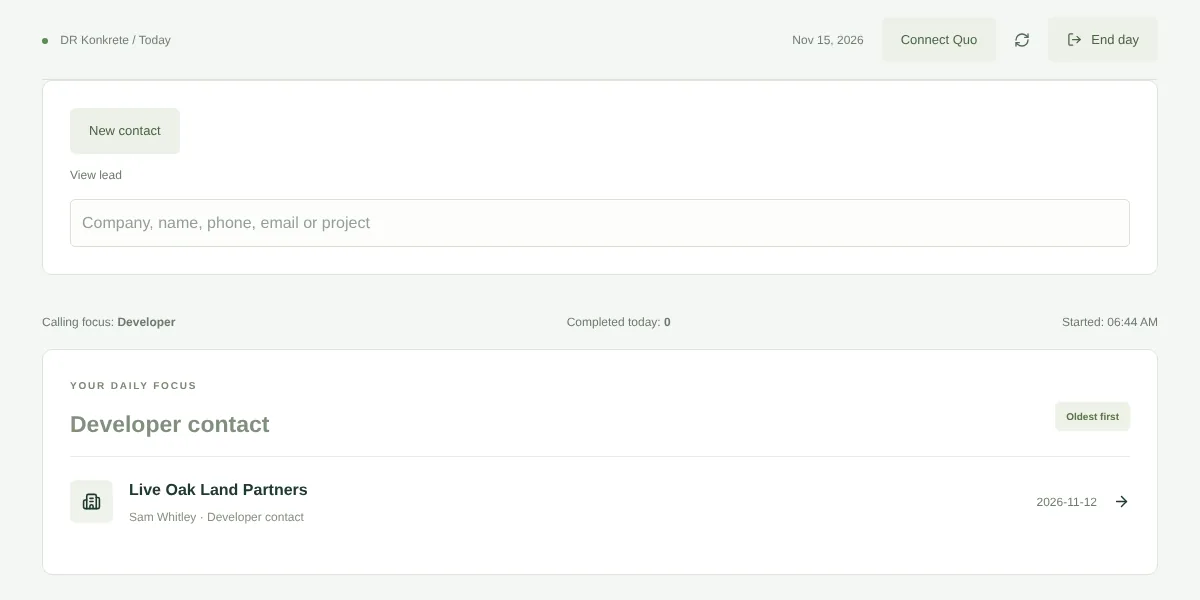
- Calling queueBuilt and in useEach caller's list for the day by customer type, one call per company per day, each contact on its own cycle.
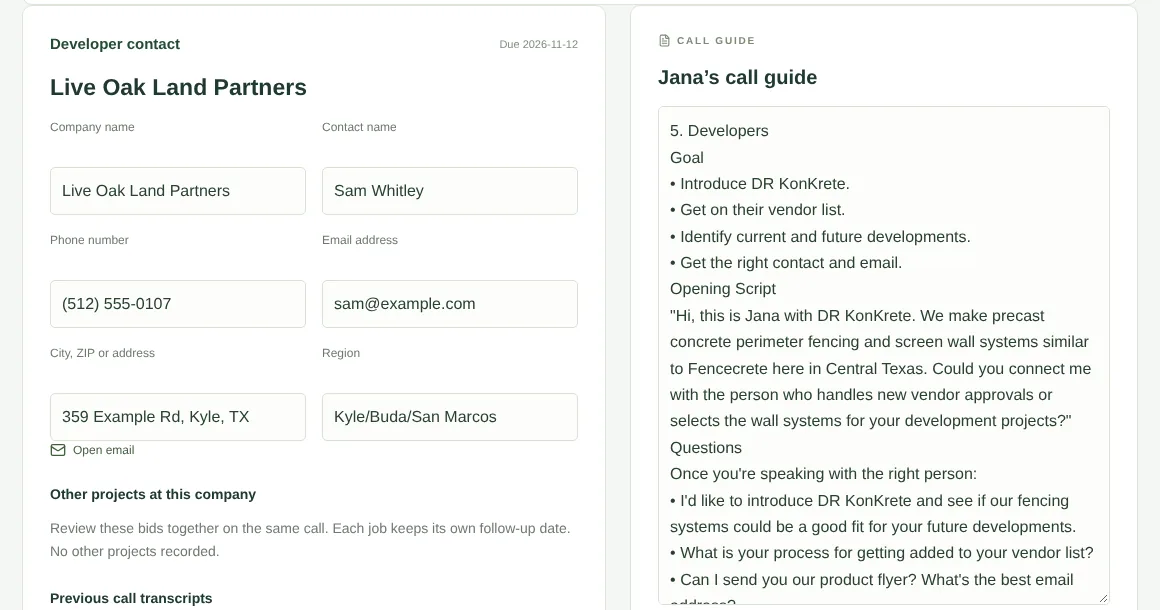
- Scripts, research and historyBuilt and in useClick-to-call with the script for that contact type, a short research brief and the full history on one screen.
- Outcomes that set the next dateBuilt and in useEvery call result sets the next follow-up for the right person; promised callbacks come first, and a real email resets the clock.
- Documents from templatesBuilt and in useThe current proposal or product sheet, sent from the shared inbox and saved to the contact.
- Bids beside the callsBuilt and in useEach bid's revision, pricing and result next to the contact, with other projects at the same company.
- Sale to operations hand-offBuilt and in useA won bid reaches the owners with the address, contact, scope and site checklist.
- InventoryBuilt and in useWhat's on hand and what's reserved for which job.
- Task hand-offsBuilt and in useEach step has an owner; when one finishes, the next person is told.
- Cost segregationBuilt and in usePayments split into tax, shipping, commissions and operations; costs tied to the job.
- Customer feedback loopPlannedA check-in after delivery; problems go to an owner, happy customers get a review request.
What it connects to
| Connects to | What flows |
|---|---|
| The team's spreadsheets | New leads and bids, imported weekly without overwriting notes |
| The phone system | Click-to-call, call logs and transcripts |
| The shared inbox | Documents sent from templates; replies reset follow-up dates |
| Online payments and accounting | Payments tied to the job and split by category |
Results
6 to 8 hours
a week back for the business developer
20% more
done by each caller
7 new prospects
found every week
1 more conversion
from the same calling effort
Measured by the owners within weeks of going live. These are results from one business; every business is different, and we'll estimate yours in your Operations Map.
Fell within weeks of going live
Climbed as research and follow-up ran on the process
Illustrations, not measurements.
How the owners' work changed
The owners stopped being the switchboard. Won jobs arrive complete, the yard and the money are visible to the people who need them, and the business developer spends the time he got back on conversations instead of spreadsheets.
See the sample Operations Map for this business →